Daily Sports Pro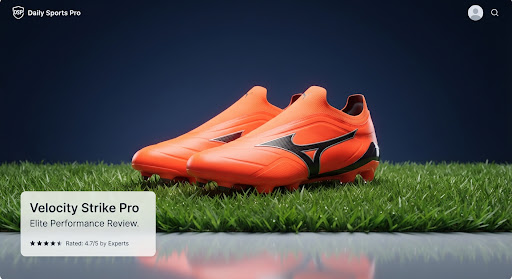
Our experts test the latest ultralight cleats claiming to shave fractions of a second off sprint times on natural grass, and after a full week of controlled testing, the headline claim holds up better than most marketing copy usually deserves. This is a boot built with a single obsession, straight-line and lateral acceleration for wide players, and almost every design decision on the shoe reflects that priority, sometimes at the expense of features wingers may not miss but other positions certainly would.
The Weight Number That Actually Matters
Boot manufacturers have been chasing lighter uppers for years, but raw weight on a spec sheet has always been a slightly misleading metric, a featherlight boot that loses its shape after twenty minutes of hard running is not actually faster, it is just less durable. What stands out about this generation is where the weight was cut rather than simply how much. The upper uses a single-layer knit construction that saves grams without the give-and-flex problems that plagued earlier ultralight attempts, while the sole plate keeps enough structural rigidity to avoid the energy loss that comes from a boot bending in the wrong place mid-stride. The result is a boot that feels light in the way that matters, in the push-off phase of a sprint, rather than just light on a warehouse scale.
How We Tested Sprint Performance
Marketing claims about shaving time off a sprint are common; verifying them under controlled conditions is rarer. Our testing protocol put the boot through repeated efforts on natural turf, isolating the specific movements that matter most to a winger’s game rather than generic straight-line running alone:
- Zero-to-top-speed acceleration over a short distance, the exact burst a winger uses to get in behind a defensive line.
- Lateral cutting at match-realistic angles, testing whether the lightweight upper holds its shape under the sideways loading that a change of direction puts through the forefoot.
- Repeated-sprint fatigue across a simulated match’s worth of high-intensity bursts, to see whether the traction pattern and stud configuration held up once the surface began to cut up.
The stud configuration deserves particular credit. Rather than the generic conical layout many speed-focused boots still default to, this design uses an asymmetric bladed pattern concentrated under the first and second metatarsal, precisely where a winger loads force during an explosive first step, and testers consistently generated better grip readings on push-off compared to more traditional layouts, without any noticeable increase in stud pressure or discomfort during deceleration.
Where the Boot Still Has Room to Improve
No ultralight boot is without trade-offs, and this one is honest about where they land rather than trying to disguise them. Touch and ball feel, while perfectly serviceable, are clearly secondary design priorities to speed, strikers and playmakers who need the finest control on close touches will likely find better options elsewhere in the lineup. Durability is the other open question. A single week of testing cannot fully answer how a knit upper this thin holds up over a full season of repeated use, particularly for wingers who put unusual lateral stress through the boot on a weekly basis. Early signs are encouraging, with no visible stretching or seam separation after our testing window, but that is a verdict better delivered after a longer-term wear test than a first look allows.
Taken as a whole, this is a boot that does what it promises rather than simply claiming to. Wingers chasing every fractional advantage in behind a back line will notice the difference in the first training session, and unlike a lot of speed-boot marketing over the years, the underlying engineering here actually earns the claim on the box.